You still flinch reaching for the top shelf.
When a wound reopens, or you spend weeks afraid it might, the scare tends to stay long after the scar fades. One part of you keeps watch around the clock. Another insists you're fine, even on the nights you're plainly not.
Those parts are working hard to keep you safe, and they've earned some curiosity instead of a lecture. Internal Family Systems therapy starts from exactly that place.
If IFS already makes sense to you, the harder question is a practical one. How do you find an IFS therapist Bellingham WA residents can trust, and then actually get a spot on their calendar?
Start with the letters after a name.
TL;DR Quick Answers
IFS Therapist Bellingham WA
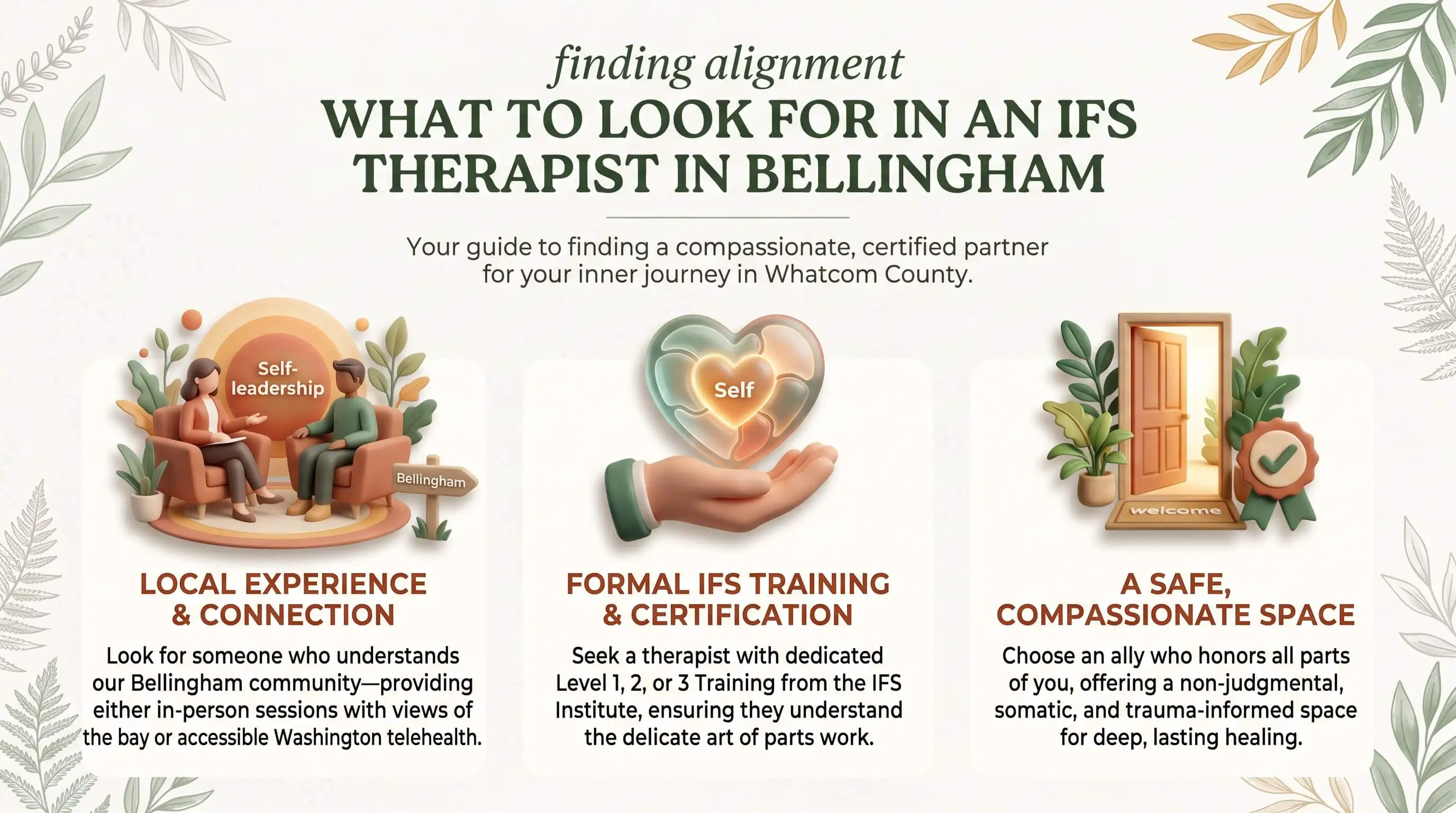
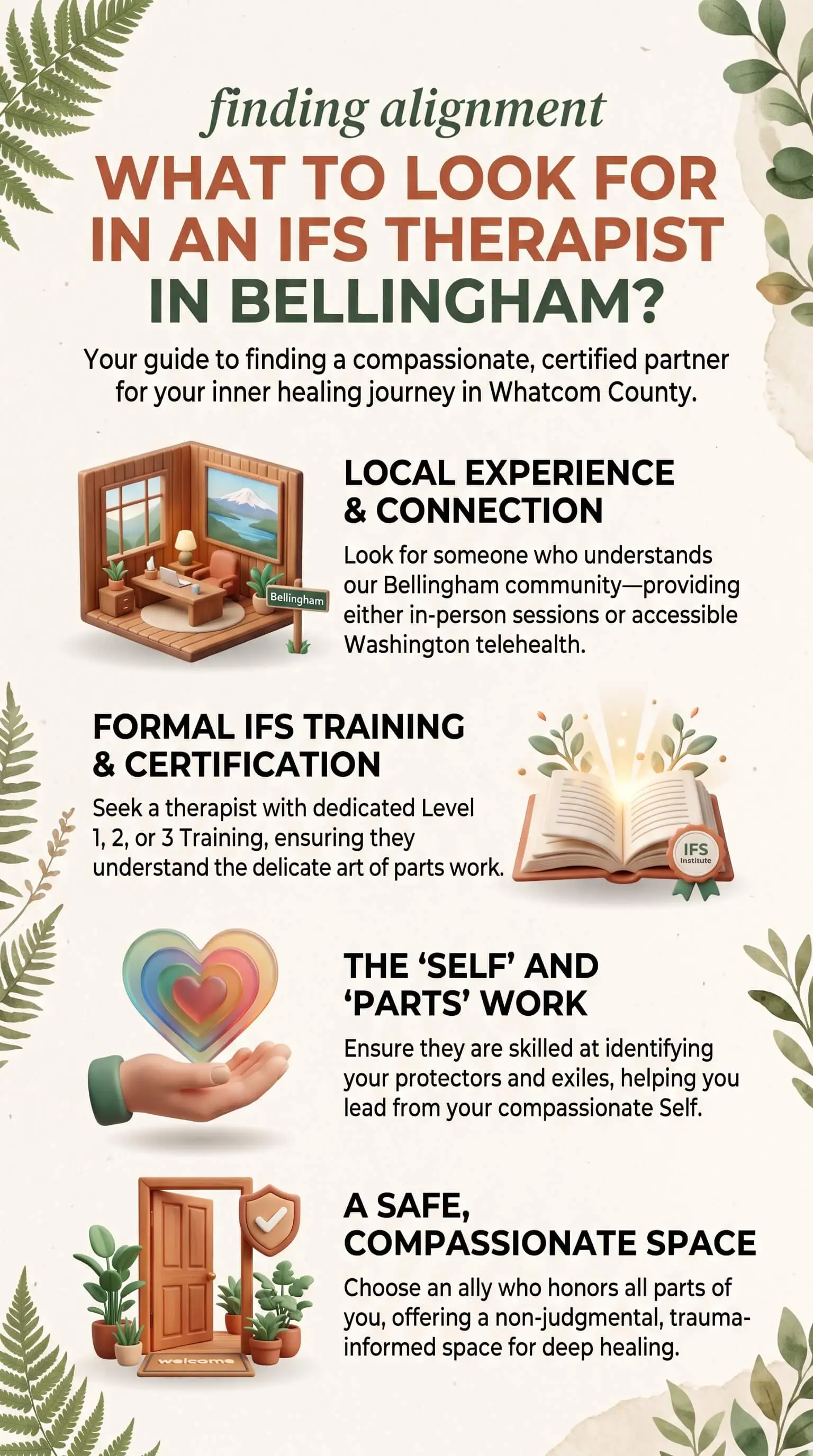
Look for an active Washington clinical license first and formal Internal Family Systems training through the IFS Institute second. IFS-trained clinicians in Whatcom County are few and often full, so many Bellingham adults see a Washington-licensed IFS therapist by secure video instead.
License: LMHC, LICSW, LMFT, or psychologist. Verify it in the Washington Department of Health's Provider Credential Search.
IFS training: Level 1 at minimum. Check the IFS Institute's public practitioner directory.
Focus: Trauma, complex PTSD, anxiety, attachment wounds, perfectionism, or the emotional weight of a hard medical recovery.
Online option: A Washington-licensed therapist can see you by video as long as you're in the state during the session.
Fit: Use the free consultation to notice whether your guarded parts settle a little. That matters more than the longest list of training sessions.
Crisis: Call or text 988, or call 911 if you're in immediate danger.
Top Takeaways
An active Washington license comes first, with IFS training on top of it.
"IFS-trained" and "IFS-informed" can mean very different things, so ask and check the IFS Institute directory.
Look for a therapist whose focus lines up with what you're bringing.
Online sessions widen your options across Whatcom County and can shorten the wait.
Use the free consultation to test fit first and sort out logistics second.
What "IFS-Trained" Actually Means
An IFS-trained therapist has finished formal training in the Internal Family Systems model, usually through the IFS Institute. Dr. Richard Schwartz developed IFS and founded the Institute, and most clinicians treat its training as the standard.
The Institute runs three levels of training. A clinician reaches Level 3 by completing Level 1, at least one Level 2 program, and then Level 3 itself. Certification stands apart from the levels as its own advanced assessment.
IFS Level 1: Foundational, structured training in the model. Most IFS clinicians begin here.
IFS Level 2: Added training, often centered on a specific population or concern.
IFS Level 3: Advanced training that follows Level 1 and at least one Level 2.
Certified IFS Therapist: A separate assessment of skill in the model. Every certified clinician has completed at least Level 1.
You'll also come across "IFS-informed." Sometimes the phrase reflects real training, and sometimes it points to a weekend workshop or one very good book.
Both have value. They just aren't the same, so ask. The IFS Institute keeps a public directory where you can check a clinician's training level yourself.
Credentials to Check for an IFS Therapist in Bellingham, WA
A Washington State clinical license comes first. IFS training sits on top of that license and never stands in for it.
These are the letters you'll see most often on Bellingham profiles:
LMHC: Licensed Mental Health Counselor
LICSW: Licensed Independent Clinical Social Worker
LMFT: Licensed Marriage and Family Therapist
PhD or PsyD: Licensed Psychologist
LMHCA or LMFTA: Associate-level clinicians who practice under a supervisor
Associates can be lovely therapists. A supervisor simply comes with the arrangement, and you can ask how that works.
Checking a license takes about two minutes. Washington's Department of Health runs a free Provider Credential Search; type in a name or license number and it shows any disciplinary action on record since July 1998.
That's less time than it takes to find parking downtown.
Matching Their Focus to What You're Carrying
IFS can stretch to fit a lot. Most therapists who practice it do their best work with a handful of concerns, and the good ones will tell you which.
IFS often fits well for:
Trauma and complex PTSD
Anxiety that won't listen to reason
Attachment wounds and the relationship patterns they leave behind
Perfectionism and a loud inner critic
The emotional weight of a long or complicated medical recovery
That last one deserves a closer look.
After a surgical complication, a protective part might scan every twinge for danger while another shuts the whole subject down. IFS doesn't try to argue either part into silence. It asks what each one fears would happen if it stopped.
Pay attention when a therapist tells you plainly what they don't treat and offers a referral. That kind of candor about fit is a good sign.
A Fairhaven Office or Your Own Living Room
Many adults do well with IFS over secure video. Others feel steadier sitting in a room with another person, and either choice makes sense.
Think about a Tuesday in November. Rain blows sideways off the bay, your session starts at 5:30, and you're on your own couch with a mug of tea instead of circling the block for parking.
Washington has one rule that matters here. A therapist licensed in the state can see you by video as long as you're physically in Washington during the session, whether that's Bellingham, Ferndale, Lynden, or a cabin out toward Glacier.
Lauren Rath Therapy is built around that setup. Lauren runs a fully virtual practice as a Washington-licensed counselor trained in IFS through the IFS Institute. Her page for people looking for an IFS therapist Bellingham WA explains how sessions work for Whatcom County clients, who she sees, and who she refers elsewhere.
In-person may suit you better if home doesn't offer a private corner, or if screens leave you feeling far away. That's worth knowing about yourself.
Waitlists, Insurance, and What You'll Pay
Whatcom County has only a small number of IFS-trained clinicians, and many of them are full. Scroll the local directory listings and you'll see "waitlist" and "not accepting new clients" again and again.
Opening your search to Washington telehealth can shorten that wait considerably.
On insurance, one question covers most of it: are you in-network with my plan? Plenty of Washington therapists work with Premera, Regence, Blue Cross Blue Shield, Aetna, or Cigna, though every practice keeps its own list.
If you're paying out of pocket, the federal No Surprises Act protects you. Providers must give uninsured or self-pay clients a good faith estimate of expected charges when you ask for one, or when you book at least three business days ahead. Ask for it in writing.
What to Ask on a Free Consultation Call
Most IFS therapists offer a short, free consultation. Use it.
What IFS training have you completed, and through whom?
What type of Washington license do you hold?
What do you see most often in your practice?
What does a first session usually look like?
Do you work online, in person, or both?
Are you in-network with my insurance, or can you send a good faith estimate?
What happens if part of me isn't sure about any of this?
How can you tell when IFS isn't the right fit for someone?
After you hang up, give yourself a minute before deciding anything. Notice whether you feel a little lighter or a little more guarded. Either reaction tells you something about fit.
Support While You Wait
Waitlists are real, and hard weeks don't wait for an opening.
The NAMI HelpLine offers free peer support, information, and referrals Monday through Friday, 10 a.m. to 10 p.m. Eastern. You can call 800-950-6264, text "helpline" to 62640, or chat online.
The HelpLine isn't a crisis service, and neither is a therapist's website. If you're in crisis, call or text 988 right now. If you're in immediate danger, call 911.
“By the time someone books a consultation with me, they've usually already read my credentials. The call is for something else. What they're really testing, often without knowing it, is whether the part of them that's been holding everything together can set it down for a minute. So I ask people to bring the skeptical part along, the one that's sure this won't work. In my experience, that part has usually been working the hardest of anyone, and it deserves a thank-you before it deserves an argument. If a therapist hurries past it, keep looking."
7 Essential Resources
NAMI HelpLine: Free peer support, information, and referrals by phone, text, or chat on weekdays.
IFS Institute: What Is Internal Family Systems?: A plain-language introduction from the organization the model's developer founded.
IFS Institute Practitioner Directory: Look up a clinician's IFS training level or certification.
Washington State Department of Health Provider Credential Search: Confirm a Washington license and check disciplinary history.
988 Suicide & Crisis Lifeline: Free, confidential support by call, text, or chat, any hour of any day.
CMS No Surprises Act: Overview of Rules and Fact Sheets: Your right to a good faith estimate when you're uninsured or paying yourself.
NAMI Whatcom: Local support groups, classes, and resources for Whatcom County residents and the people who love them.
These essential resources can help you find qualified healthcare professionals offering IFS therapy in Bellingham, Washington. The IFS Institute and Washington State Department of Health provide tools to verify therapist credentials, while NAMI and NAMI Whatcom offer mental health support and referrals. Additional resources explain patient billing rights and provide access to 24/7 crisis support through the 988 Lifeline.
3 Statistics
In 2022, 23.1% of U.S. adults, about 59.3 million people, lived with a mental illness. (NIMH) Looking for a therapist puts you in a very large company.
An estimated 19.1% of U.S. adults had an anxiety disorder in the past year. (NIMH) Anxiety ranks among the most common reasons people go looking for IFS in the first place.
Just 50.6% of U.S. adults with a mental illness received any treatment in 2022. (NIMH) About half go without. Waitlists and the slow work of finding someone who fits both feed that gap, and you can plan around each of them once you know they're coming.
Mental health conditions affect millions of U.S. adults, with 19.1% experiencing an anxiety disorder in a given year. Yet only about half of adults with mental illness received treatment in 2022. Finding a qualified IFS therapist for anxiety can be an important step toward managing emotional challenges, making it essential to consider therapist availability, waitlists, and finding the right fit.
Final Thoughts and Opinion
The right IFS therapist won't always be the one with the longest list of training. More often, it's the one your guarded parts slowly begin to trust.
Licensure and training are the foundation. Fit is the house you'll actually live in, week after week, while you get to know the parts of you that have been quietly running things for years.
I'd rather see someone choose a Level 1 trained therapist they feel safe with than an advanced one their protectors never warm up to. Insight is easy to come by these days, in books and podcasts and late-night scrolling. What's harder to find is a room where those protectors feel safe enough to rest.
And if your body has been through something hard lately, give yourself some credit for tending to the parts the stitches couldn't reach.
Frequently Asked Questions
How do I find an IFS therapist in Bellingham, WA? Search the IFS Institute's practitioner directory alongside local therapy listings, then confirm each clinician's license through the Washington Department of Health's Provider Credential Search. If local therapists are full, look at Washington-licensed IFS therapists who work online.
What's the difference between IFS-trained and a Certified IFS Therapist? IFS-trained usually means at least Level 1 training through the IFS Institute. Certification is a separate assessment of skill in the model, and every certified clinician has completed Level 1 or more.
Does online IFS therapy work? For many adults, yes. IFS is a conversation-based approach, and it carries over well to secure video. You may prefer in-person if home lacks a private space or screens feel distant.
Will insurance cover IFS therapy in Washington? Often it will. Insurers cover therapy from a licensed clinician rather than a specific method, so ask whether the therapist is in-network with your plan. If you're paying yourself, ask for a good faith estimate.
How long does IFS therapy take? That depends on what you're bringing. Some people notice small shifts within a few months, while trauma or attachment work usually takes longer. A good therapist checks in with you about pace along the way.
Do I need to know about IFS before starting? No. You don't need to read anything first or learn the vocabulary. Your therapist will bring in the ideas as they become useful.
What if I'm still recovering from surgery or a medical setback? That can be a good time to begin, since medical stress often wakes up fear and hypervigilance. Keep your medical team informed, and tell your therapist what your body has been through.
Book a Free Consultation
You don't need a polished reason to reach out. One sentence will do, even "something hasn't felt right since the surgery."
Lauren Rath Therapy offers a free 15-minute consultation for adults anywhere in Washington, Bellingham and Whatcom County included. No pressure, no obligation. Just a chance to see whether your parts feel at home.
Book a free 15-minute consultation